━ English Version
Book Presentation by Ricardo Wiesse 2024
I have seen this exhibition several times and reread the introductory text I wrote almost a year ago, and I reaffirm each of my statements. Only silent, respectful gazes are possible before spaces that have ceased to be profane, connecting us to another dimension where silence reigns. Although adjectives, intellectual constructions, explanations, or prior narratives are unnecessary here, I will now attempt to convey my impressions.
The painter has poured his life into these works. In each of these pieces, we recognize not only the hours invested in manual labor, but also a profound commitment to the values and ideals they embody.
These paintings are not merely dazzling surfaces: they are living organisms that pulse, vibrate, and celebrate themselves as achievements of sustained control across the full extent of their rectangles. The artist has not neglected a single square centimeter, like a pianist who performs his score flawlessly, both formally and expressively, from the first to the last note. The sensation that permeates the viewer upon leaving this room can be summarized, without exaggeration, in the words of my friend Raúl Gutiérrez: “It is miraculous.”
The contrast between the chaotic, anomic reality of our global present and the works we see here could not be greater. On the side of “reality,” everything seems to collapse, to regress, to dissolve into a darkness that returns us to undifferentiation, generating ominous forebodings. Fragile as houses of cards, our social institutions crumble with no new horizon in sight, suffocated by greed and arbitrariness that have undermined our history for centuries. Leaderless, with the political sphere hijacked by corruption in all its forms, and Nature wounded to the point of dismemberment, we walk straight toward the abyss. Amid this chaos, Peschiera has gathered his paintings and constructed with them a liberated, uncontaminated zone that keeps the forces of dissolution at bay.
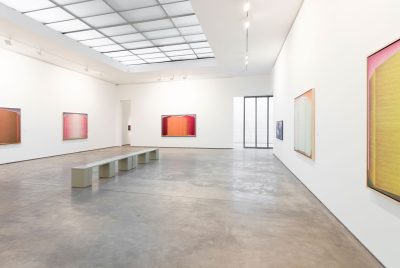
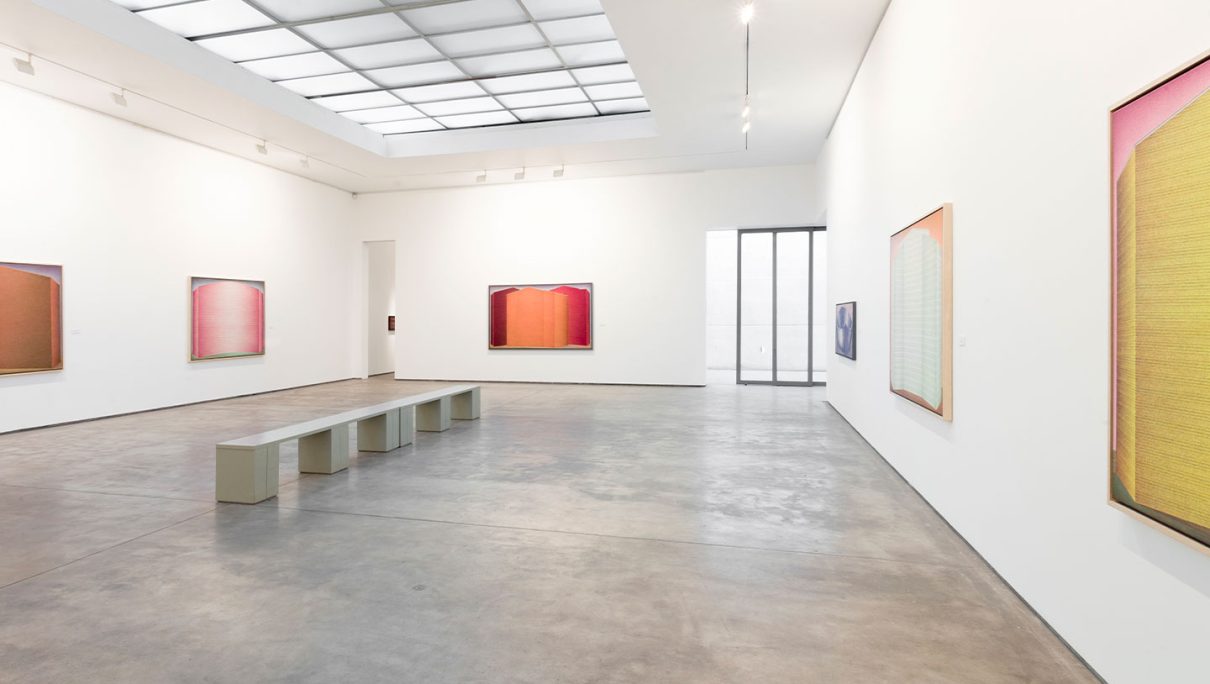
Painted in a dark violet hue and impeccably arranged with the works distributed along its walls, this room becomes a declared nucleus of resistance against despair. Its creator has waged a prolonged battle with the social, cultural, and artistic conventions surrounding him. Clinging to his own mast, he has deepened paths he envisioned decades ago, stripping away all symbolic objects except for the wall.
His “mantos” testify to a profound respect for the world’s many architectural settings, exalted through the memory of real places and the dedicated learning from master painters throughout art history. Laborious, disciplined, devoted to his craft, he masters ancient techniques that have nearly disappeared in this age of immediacy, short-term thinking, and trivial entertainment.
In the catalogue designed by Nelly Murdoch, several double-page photographs focus on books, brushes, and jars of powdered pigments: the tools of a vital pact in constant combustion. The volume we present tonight includes images of viewers and their moving shadows before the static works, not only conveying scale, but also alluding to the inevitable transience of this exhibition, which will reside in the memory of those who experienced it as a gift that awakens, expands, and reinforces transcendent aspirations, beyond reason and beyond the monsters foretold by Goya.
A long journey has led Peschiera to his large formats, where the hypnotic effect of color intensifies. Applied in countless brushstrokes—points and commas that repeat a gesture always alive and splendidly varied—the large scale allows the full display of his chromatic fields. These are achieved through extremely subtle tonal gradations, calibrated with such precision that they convey—through the illusory means of painting—a sense of solidity comparable to the architectural space that contains them.
Geometric forms—solids, the most simple, universal, timeless shapes—emerge from a remote memory of the species. As enclosed regions of space, they are stable, perfect, regular, measurable. Immune to change, they reflect the supreme order that governs and harmonizes the cosmos. Imposing and fantastical, drawn with extraordinary control, Peschiera’s structures gently immerse us in the rigorous perspectives of their courses, transforming what might be accumulations of bricks into visual scores.
It is possible that within these tall structures, meditation and prayer take place at an unseen dawn, hidden from this side, where the blind wall conceals their occupants—imaginary guardians of a static time, isolated from the transient world, already inhabiting eternity behind them. Their architect has assigned them no other function than to make visible feelings, ideas, and intuitions that can only be realized through painting.
The most complex compositions assemble concave and convex blocks in precisely balanced volumetric relationships. Between them appear fissures and discreet passages that invite the viewer to imagine entering beyond. Everything points upward, without spectacle or ostentation. These monuments reactivate marginal, postponed ideals of austerity and restraint—vehicles for an ascent toward a higher plane of existence, both intelligent and sensitive.
The painted surfaces, smooth and uniform, vibrate with juxtaposed colors, agitated like traces of brushstrokes—points and commas, corpuscles, atoms suspended—echoing lines from Lucretius’ De Rerum Natura, where light is described as particles floating in space. Peschiera’s brushstrokes immerse us in the same theme—light—arriving at remarkably similar conclusions across two millennia. Some surfaces possess the weight and consistency of stone or fired earth; others the fluidity of water, the lightness of air, or the force of fire. A pair of red facades resonates behind the eyes, fixing themselves in memory like rubies. These intensities are achieved through controlled, repeated gestures, enveloping the viewer in a warm, calming, and fascinating atmosphere.
Layer by layer, pigments mature across each canvas. Their subtle variations reformulate timeless, universal questions in painterly terms. The painter admits that he “pushes things a bit,” aware of the complex effect his work generates. His primary aim is undoubtedly color. Peschiera has taken color to a remarkable level of development—or perhaps color has led him along its royal path. In any case, painter and color merge into the unity of each piece. Color does not lie: achieving a musical level is arduous, but once attained, the victory is undeniable. Having conquered light, everything becomes possible.
His achievement is not sudden or Promethean, but the result of patient dedication, discipline, and lifelong dialogue with art. Without intending to, the artist acts as a connector between a world threatened by its own irrationality and the visible magic of poetic language and human aspiration. Free from doctrinal implications, his spirituality shines quietly, like a gift from one spirit to another. These paintings emanate a primordial silence. They belong to the realm of the magical—receptacles of stillness and peace, glimpses of a hidden reality awaiting us beyond time and space.
Like a desert monk, the artist withdraws from noise to enter the mystery of the soul. His paintings remind us of a forgotten greatness within us. Painting, like all true art, can provoke revelation—as Rilke writes in Archaic Torso of Apollo:
“You must change your life.”
Painting indeed can be miraculous, even as the world falls apart.