━ ENglish Version
Text by Ricardo Wiesse 2024
TO SEE, TO PAINT, TO THINK
“There is in what I see something which I do not see. That makes the magic of what I see.”
Roger Munier
“The rose is without ‘why’; it blooms simply because it blooms.”
Ángelus Silesius
Pedro Peschiera’s trajectory of life constitutes, vitally and artistically, a peculiar case among Peruvian painters of his generation: born and trained in Lima, he emigrated to Switzerland more than four decades ago. Established in Geneva, he develops on the shores of its large lake a complex, enigmatic work, crafted in absolutely personal terms. Despite the distance that completely sets them apart from the current trends and common places of these times, the formal and conceptual riches displayed in his canvases are established and rooted in their own right in the turbulent areas of our contemporaneity.
A passionate student of the cultural traditions of the so-called Old World by the Christian conquerors of America, Peschiera became familiar with the symbolic universe of medieval architecture, with the master painters of the first Renaissance, with the mannerists and with the moderns, all assimilated by his critical and markedly selective spirit. In his works the chromatic keys of the desert coast of his homeland also persist, although veiled, evocations of a nostalgic bond that he is not willing to lose. “Being Peruvian,” he declared, “and deeply loving European art and culture, being immersed, but always knowing that I am not European and that I will never be able to be one, that I will always be far away, constitutes a large part of my Peruvianness.” Full stop. Going deeper into this question is irrelevant: his visual achievements distinguish him as an independent and reflective cosmopolitan creator, embarked on a search for a transcendent content, and not at all concessive with the changeable compulsions of current tastes and the market.
In a sense opposed to that of the artistic avant-garde that more than a century ago renounced its own civilizational foundations and resorted to the exoticism of the “primitive” peripheries in search of uncontaminated air, Peschiera delves fundamentally into classical Greco-Latin antiquity and its ancient legacy. Solitary – although not isolated – his vision and practice challenge the impositions of dominant, authoritarian, discriminatory thought, typical of our thanatized present, subjected by fanaticism and irreducible fears. How does a temperament like his respond to the sliding collective march towards self-destruction, despite the scientific and technological advances that amaze us every day?
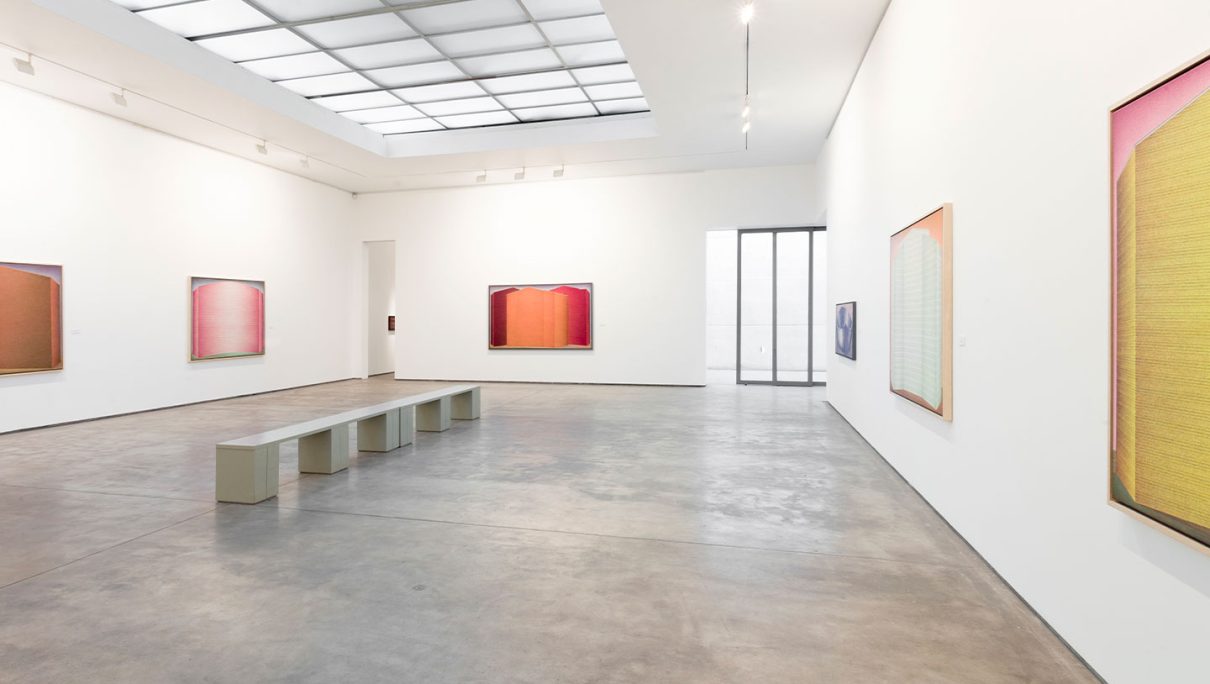
Peschiera’s paintings are part of a counter-current plea —although marginal, barely visible, silenced under the prevailing dissonances— to preserve values in every area and order of things. Dedicated to the cultivation of inalienable ideals, he faces the persistent challenge of collective death with the available weapons of his mental and manual creativity. His is a tenacious, quiet, lucid fight against escape exits and the fallacies of immediacy spread over the face of the earth. Stubbornly, the artist imagines and conquers spaces freed from the surrounding nightmare. In his work, COLOR, the main protagonist of the art of painting dominates, sovereign, self-sufficient and imperturbable. His immobile, serene compositions, filled with contemplative qualities, are empty settings, radically devoid of all agitation and animated presences. There the viewer is immersed, bathed in chromatic transparencies like those of medieval stained glass. Delicate to the highest degree, these tonal gradations seem to come from an alternative universe, contrasted in their harmonious perfection with the somber violence of the world that is imploding before our stupefied gaze. Discreetly, the painter—despite or thanks to his declared agnosticism—perseveres and excavates tirelessly, confident in the superior capacities that he recognizes in himself and, by extension, in all of humanity. In an inconspicuous manner, his practice emulates his ancestors in the Roman catacombs, who left behind their salvific emblems before being devoured by wild beasts driven mad by hunger. One of his statements is particularly illustrative: “The religious link may no longer be there, but the trace still remains.”
“My painting could not have existed in another time,” he clarifies. The foundation stone of his trade, his technical knowledge—atypical in these times—comes from suppliers as prolific and affordable as never before in history, which he defines as “the enormous inventory inherited through the ages.” His cult for manual work has led him to study, among countless treatises, the 189 chapters of The Book of Art by Cennino Cennini – a student of Agnolo Gaddi, initiated in turn by his father, Taddeo, godson and disciple for 24 years of the great Giotto—and to personally contact artists such as Tilsa Tsuchiya, who instilled in him her love for the quality of the pictorial surface, as well as her discovery of glazing. Another great Peruvian painter, Julia Navarrete, exerted on him her teaching uninterruptedly since her distant days at the then School of Plastic Arts of the Catholic University of Peru, where its director Adolfo Winternitz repeated like a mantra that the artist’s work consisted of “10 percent inspiration and 90 percent perspiration.” His intellectual concerns took him for several semesters into the classrooms of such distinguished teachers as the humanist George Steiner, he became familiar with modern literature as well as with the texts of the First Fathers of the Church – Origen, John Damascene, Augustine of Hippo – and to venture temporarily into Cistercian monasteries to experience firsthand the daily austerity of their occupants. His pictorial themes faithfully testify to the same radical renunciation and respectful approach to the strict rule of these renunciates, at the antipodes of the headless hedonism that distracts and subjugates the common layman.
Peschiera describes himself as “someone who loves painting” and acknowledges: “My painting and its space and even its color has something intrinsically Italian.” With this, he genetically claims a sensitivity nourished by his exhaustive artistic visits to the land of his elders. Free of pretense, he always tours museums and monuments in admiration, and unintentionally continues the path of the cave magician, the desert hermit, the Romanesque architect, the Gothic stonemason and the solitary avant-gardist, turned into a medium who links the high and the low. Transmitter of avid and laboriously assembled beauties, he lives to paint, convinced that his routine in front of the easel is transmuted into personal fulfillment. Only then does he become the first spectator of astonishing births, a generator of meaning and incomparable surprises. Fascinated with the emotional and sensual power of color, he checks how much each strip of the rainbow influences the content of a painting: “It is as if the paintings manifested their need to be, their urgency to exist.”
The infinite possibilities of superimposition, the juxtaposition or the vicinity of color fields – as demonstrated by the works of Mark Rothko and Josef Albers, the first «atmospheric» and the others «hard-edged» – as well as their approaches and variations, function as “guarantors of the non-exhaustion of forms.” If at the beginning Peschiera kept his distance from the best painting of the last century (“the avant-garde,” he maintained, “had little or nothing to do with my relationship with life or the world”), his appreciation changed in the face of Kazimir Malevitch’s paradigmatic work. Malevich and his followers, especially the American minimalists. Inspired by the statement “less is more”, coined by the architect Mies Van der Rohe, the (almost) monochrome squares of Ad Reinhardt, the reticular plots of Agnes Martin, the “religiosity without images” of Brice Marden and a long list of artists, influenced decisively in the remarkable turnaround of his painting in recent decades, when he brightened-up his palette and reemphasized the plane as a receptacle of reverberant interactions, of joyful vibrations. This crossroads led the painter to clarify his desire to “force things a little” and “transfigure” them.
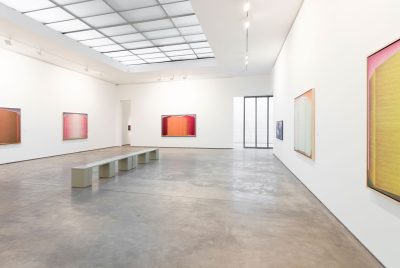
Far from mimetic desires, Peschiera erects fantastic walls, smoothes-out facades embedded with topazes, sapphires, emeralds, amethysts and countless jeweled particles, solidly cemented by geometry. These architectural elevations—we speculate—would have delighted Georges Seurat as a reflection of his most audacious dreams and intuitions. His technique perceptively dismantles the common visible continuity into tiny units, fused by the science of color: the feast for the eye contained in the prematurely truncated approaches of the French pointillist master. The hand and sensitive understanding are the pulse of these splendid planes, they qualitatively surpass the routinely observable reality and reach auratic dimensions as familiar to the ancients as they are strange to current views, satisfied and atrophied by their devices and pixels.
An arc of sixty millennia rises between the aboriginal art of Australia – the oldest living culture on the planet, where the “dot” is still used in Dream Time recreations to this day – the late works of Vermeer, “chromoluminarism” – or “divisionism”—post-impressionism of Seurat and Signac, the dotted surfaces of Parisian synthetic cubism known as “confetti” and the “benday” dots of Roy Lichtenstein. In his theoretical texts, Vasili Kandinsky defined the dot as “the simplest unit of the image”, whose repetition enables “different visual sonorities” to be achieved. This succinct account does not intend to exhaust the precedents of the works discussed here, only to give an idea of the omnipresence of this primary element of painting, “origin,” in Kandinsky’s words, “of the rest of natural forms.”
Solid, massive like the basic geometric figures, the parallelepipeds built by Peschiera stand with their feet firmly planted on the ground. Their elemental forms rest on the rigorous, patiently calibrated measurement of the linear structures projected as safe receptacles for subsequent chromatic displays, planes differentiated by the tones of their slightly contrasting orientations, without any allusion to the hours or the passage of time, as to the shadows cast by the Sun as a source of light. Fitted to the quadrangular perimeter laid with the precision of the great perspectivists (Alberti, Uccello, Da Vinci), in these polychrome screens the conventional dichotomies of figuration/abstraction, past/present are dissolved, and the gravitating opposition between retinal painting and conceptual art, is as captivating as the insolent, playful and subversive personality of its author, Marcel Duchamp. Peschiera’s inventions cannot be assigned to any previous style, apart from their vague, distant Romanesque air. If we dispense with the allusions to the physical world—the static floors and skies that frame them— only progressive horizontal parallels, symmetrically arched, schemes barely differentiated from each other will remain. They are abstract constructions, concretions of objects lodged in the mind, which he draws, turns, and scrutinizes at will, he navigates intellectual labyrinths and transforms them into dreamlike captures. They imitate nothing. They open as autonomous bodies and scores where visual harmonies resonate, configured by themselves as unclassifiable expressions of a slow and secure gestation, assignable—given that pictorial art lacks a specific muse in the Greek pantheon—to Terpsichore, “she who delights in the dance».
It is amusing to imagine what Marcel Duchamp would have thought of Peschiera’s emulsified tempera paintings, so seductive to the retinal lenses and simultaneously carriers of ideas elaborated by an expressive need. These considerations lead us to repeat a truism: there is no art without concepts. Perhaps the author of the Ready-mades would have distanced himself from his ingenious and revealing linguistic games and openly reconciled himself with the mysteries of pictorial art and its consubstantial silence. (It is no secret to anyone that, despite his inflammatory statements, the great Marcel never stopped painting). Perhaps, in the face of these meticulously thought out and manufactured displays—intricately sensitive and intellectual—he would have advocated for a more than pertinent and necessary re-materialization of art.
What do we find behind the Mantos and the dazzling facades, but a landscape populated with previous symbols, that is: boats, shells, tables, wells, bowls, bells and other containers of the void? A long, winding path has led the painter to conceive and develop these planes stratified by precise lines, these bare lines, progressively arched like open books that embrace us between subtle modulations. A lyrical, quiet, imposing breath, at the same time solemn and light, shines in these wefts of stone or brick. Identifying the material is unimportant: it is just paint, just touches of egg tempera, a recipe inherited from Byzantium, from the miniaturized manuscripts, from the hermit monks who fly invisible over these surfaces. Carved with superlative diligence, these walls condense a unique meaning, unusual in these orphaned times, devoid of higher aspirations, dominated by the desire for speed and productive efficiency, premeditated and inevitably disposable.
Let’s pause briefly on the title that groups the architectures: “Arks/Karakoram-Landscape». The triad provokes an incantatory, enchanting, euphonious effect, simultaneously referring to a geological fact (the mountain range called Karakorum in Turkish, which means ‘black rock’, equivalent to the term Krishnagin, ‘black mountains’, in Sanskrit), to Bible history (the Ark of the Flood or that of the Covenant of the Hebrew people with Yahweh) and a fantastic conception of the landscape seen as the sum and receptacle of architectural peaks. The associated names contain their own logic. They enunciate in Peschiera’s personal key the complexity contained in his apparently simple constructions. Nothing gratuitous, verbal riddles add layers of meaning to the countless overlapping chromatic touches.
Painting is the outer, visible layer of the concerns that bubble within the artist. His march inward accumulates events, revelations, discoveries, assimilations and significant sediments. Intense and passionate, his reflective vein has been permanently marked by questions that do not wait for an answer: they only seek to be formulated clearly, and to open the cracks of an enduringly rooted mysticism. The traveler persists in his elucidation efforts, familiar with the spiritual achievements of all times and origins. His path advances in the company of writers as diverse as his admired Herman Melville and the metaphysical symbolist René Guénon, to authors barely known to the general public. One of the latter, Roger Munier—French disseminator of Heidegger, commentator of the quietist mystic Angelus Silesius, translator of haikus, whom he “would have liked to meet”—has written enigmatic aphorisms, like the quote that heads these paragraphs. These examples help to illustrate the painter’s prolific readings, his vocation for probing the depths, venturing into the territory of the secret, the miracle of consciousness and the wonder of living, and for inhabiting the most hidden and poetic spaces of thought.
“There is something in what I see that I do not see. That makes the magic of what I see.” That “something” is a gray, indeterminate area, oscillating between the gaze that penetrates and the mind that wonders. Simultaneously, paradoxically, it reveals and hides the insufficiencies of reason to address the mystery of being here, in this inexhaustibly interpretable phenomenal world, resistant to tautologies as well-known and popular as Frank Stella’s statement: “What you see is what you see.” Among many others, the great American painter Philip Guston agrees almost literally with Munier: “Painting is not on a surface but on an imagined plane. It moves in the mind. It’s not there physically, at all. It is an illusion, a piece of magic. Therefore, what you see is not what you see.” Both statements take us back to the famous saying of Leonardo da Vinci, for whom painting “è cosa mentale.”
The common use of our sense of sight undergoes particularly complex challenges when faced with pictorial works such as those of Peschiera, they are reluctant to be defined by reason. By broadening the conventional way—the automatic mode adopted by the eye to recognize objects—these works persuasively lead the viewer within the painted plane. The painted spaces remain invariably two-dimensional, measurable, tangible, but they give off indefinable, unusual qualities, unapproachable by words. In front of these qualities, we can only look and remain silent. The visual arts in general, and painting in particular, open access to little-explained (but no less real) domains of sensibility. They expand known frontiers, expose verbal insufficiencies, recreate preconscious dazzlement traceable to Paleolithic ritual, to the forgotten origin; buried by one of the covert adversaries of our artistic horizon: the explanatory and supposedly deciphering mania, which only spoils the silent game between stimuli and responses. We live saturated with images, concepts predigested by specialists, full of false prophets who from time to time decree the death of painting, of the easel, for whom oil paints and their solvents are synonymous with a past without a future. In truth, technological advances have demonstrated little more than naiveté: random 3D parodies, hypnotic substitutes for an increasingly infantilized mass public, ignorant along the entire line of “unplugged” values.
Pedro Peschiera’s art has reached an unquestionable level of quality. Its excellence will maintain a permanent relevance, immune to change and passing fashions. It is to be hoped that these paintings will one day be incorporated into public collections, hopefully not too far away, and their achievements will be disseminated as healing music, relief, and as an antidote to general discouragement. His paintings counteract the existential superficiality that ravages all social levels. They dignify life, exalting it. They reinforce individual defenses in these opaque times, so prone to precipitating indifference and giving up options such as refuge in the so-called “comfort zones.” Nothing falls from the sky; they seem to tell us. Like the generations that built the cathedrals defying the law of gravity, the oppressions, and the lurking dangers, they proclaim that the human soul is capable of undertaking and performing seemingly unattainable feats. These luminous works continue the instructive dictates of uninterrupted cultural transmissions, determined to vivify the remote dreams of the species, to not die. The vital will counteracts meaninglessness. It can fill it with aesthetic and moral values, confront the terrors and uncertainties inherent to our condition. A sleepless, constant, responsible task, always within reach of our hands.
Ricardo Wiesse R.